
Under the impetus of Prime Minister Mark Carney, the Canadian government has embarked on a major reorientation of its defence policy. According to him, the prevailing assumption “that our geography and alliance memberships automatically conferred prosperity and security – that assumption is no longer valid.” Canada now intends to develop military capabilities so that its “defence never becomes dependent on others again.” The ambition is colossal, given that the country’s defence was historically conceived and articulated around a close relationship with the United States. The goal is clear: “Canada is moving from reliance to resilience.”
It is in this perspective that the Canadian government unveiled its very first Defence Industrial Strategy (DIS). It calls for “maximiz[ing] secure strategic autonomy” by developing “sovereign capabilities,” supporting “our resilience in the event of a conflict,” and “reduc[ing] supply chain vulnerabilities” through the diversification of defence partnerships. This dual objective relies on a grim reading of ongoing geopolitical upheavals: “Long-held assumptions have been upended – about the end of imperial conquest, the durability of peace in Europe, and the resilience of old alliances. In this uncertain world, it is more important than ever that Canada possess the capacity to sustain its own defence and safeguard its own sovereignty.”
In reality, this narrative is misleading, as it masks the fact that the Canadian government does not truly intend to embark on a turn toward independent defence. Despite the stated ambition to strengthen Canada’s strategic autonomy, the DIS does not question the country’s structural integration into the American military and industrial architecture. It certainly proposes a military reindustrialization, but not an emancipation from the American sphere. In the absence of a new defence policy making strategic autonomy a genuine ambition, Canada’s vast rearmament plan risks perpetuating its historical model of “plug-and-play” forces integrated with the United States.
This paper develops a three-part argument. First, it shows that Canadian defence has historically been built within a framework of interoperability and complementarity with the United States, both operationally and industrially, which limits the scope of any potential sovereign reorientation. It then analyzes the government’s conception of strategic autonomy, largely reduced to a logic of domestic production and hopes for intellectual property ownership, without a clear redefinition of national security objectives. Finally, it demonstrates that, far from announcing a rupture, the DIS fits into a dynamic of continuity, where the deepening of continental integration coexists with an industrial ambition that is predominantly economic, thus revealing a partial and circumscribed autonomy.
Institutionalized Alignment
The stated ambition of the DIS suggests a profound paradigm shift. Indeed, the grammar of strategic autonomy has never structured reflection on Canadian defence policy, which has never previously highlighted the notion of autonomy, preferring instead the ambition of being a reliable and credible ally.
Thus, Canada’s defence policy has primarily been built since the Second World War according to an approach of industrial and military integration with the United States. This integration operates at several levels, which reinforce each other and deeply shape Ottawa’s strategic choices. On the military and doctrinal level, the North American Aerospace Defence Command (NORAD) is not merely a cooperation mechanism: it organizes a logic of integrated continental defence where surveillance, alert, planning, and coordination of responses to threats are organized on a North American scale. Early warning systems, intelligence sharing, aerial interception procedures, and rapid decision-making mechanisms rely on intertwined chains of command.
Similarly, Canadian military acquisitions have long been determined by their compatibility with existing American architectures, whether regarding maintenance, software updates, logistics chains, or doctrines of use. The desire for interoperability acts as a mechanism for the structural alignment of Canadian acquisitions, linking technological choices, modernization schedules, industrial suppliers, and budgetary priorities to the United States. This systemic integration into the American military ecosystem is now expressed by the wish for “interchangeability,” i.e., the ability to use the same systems, munitions, or platforms as the United States. This logic favors the purchase of systems already in service within American forces to reduce logistical and doctrinal frictions. It is in this logic that Canada plans to acquire several American platforms: F-35 fighter jets, HIMARS multiple launch rocket systems, P-8A Poseidon maritime patrol aircraft, Aegis combat systems, MQ-9B drones, etc.
This logic of interoperability, even interchangeability, with the United States should come as no surprise: Canada still operates according to the strategic orientation set by the April 2024 defence policy. The latter notably sets as an objective investing in military capabilities enabling Canada to ensure North American security within the framework of “a renewed defence partnership with the United States that is focused on restoring continental defence and deterrence in all domains: sea, land, air, space, and cyber.” This vision of a deepened partnership with Washington remains the logic guiding the ongoing recapitalization of the Canadian Armed Forces (CAF) under the Carney government. As the 2026–2027 departmental plan highlights, planned defence investments will “strengthen continental defence through continued implementation of the NORAD modernization plan announced in June 2022. [They] will enhance the CAF’s ability to detect, deter, and defeat evolving threats across domains, including through NORAD’s aerospace and maritime warning responsibilities.”
This logic of integrated continental defence is intimately linked to its industrial counterpart: a significant part of defence production in Canada relies on subsidiaries of American groups or on Canadian companies inserted into North American value chains. While the majority of companies in the defence sector are owned by Canadian interests or controlled by a parent company established in Canada, companies owned by American interests account for more than half of the industry’s total sales and nearly two-thirds of Canadian exports.
This strong North American integration is largely explained by the 1956 Defence Production Sharing Agreement (DPSA). This bilateral treaty between Canada and the United States allows Canadian companies to bid on contracts from the American Department of Defence by treating them as domestic suppliers, thus fostering joint defence and integration of supply chains between the two countries. For example, Canada’s largest defence company, CAE, provides simulation and training systems for platforms used by the US Air Force and Navy, thus inserting itself into the American operational ecosystem as a strategic provider of training capabilities. Magellan Aerospace, meanwhile, manufactures components and aerospace subsystems for prime contractors like Lockheed Martin or RTX (formerly Raytheon Technologies). Héroux-Devtek, which produces landing gear for several American military aircraft, was itself sold to an American investment firm. These examples illustrate the logic of functional specialization encouraged by the DPSA: Canadian companies generally do not design entire platforms, but they provide essential subsystems integrated into American industrial architectures.
Furthermore, several of the most structuring actors of the Canadian Defence Industrial and Technological Base (DITB) are subsidiaries of large American groups, whose presence profoundly shapes the North American integration of the sector. General Dynamics is represented notably by General Dynamics Land Systems-Canada, the primary manufacturer of the Light Armored Vehicle (LAV) used by the CAF and exported abroad, as well as by General Dynamics Mission Systems-Canada, a central player in C4ISR systems (Command, Control, Communication, Computers, Intelligence, Surveillance and Reconnaissance). RTX is present through Pratt & Whitney Canada, a pillar of the aerospace industry, as well as through its activities in radars and defence systems. L3Harris, via WESCAM, is a global supplier of electro-optical sensors, while Bell Textron Canada, a subsidiary of the American company Textron, is one of the few manufacturers of military aircraft present in Canada. These subsidiaries illustrate the deeply integrated and partially outsourced nature of the Canadian DITB.
Strategic Autonomy Reduced to Industrialism
The ambition of strategic autonomy proposed by the Carney government thus collides with profound constraints: interoperability, industrial integration, logistical dependencies, and supply structures reliant on the United States. However, this overlooks a fundamental aspect of the DIS: its ambition remains strictly economic.
Indeed, military acquisitions are now explicitly conceived as instruments of economic sovereignty and resilience. The primary objective of the DIS is to “reduce overreliance on foreign suppliers, foster national champions in our defence industry, secure sovereign control of our own equipment and intellectual property, and create value across Canadian supply chains.” To achieve this, the projected share of military acquisitions from Canadian industry will rise from 43% to 70%, a relative increase of nearly 63%.
At first glance, this might suggest that Canada is seeking to reduce its dependence on the American defence industry. However, such an interpretation would ignore the very definition of what “buying Canadian” entails. Despite its objective of developing a Canadian DITB, the DIS does not define what constitutes a Canadian company. Government officials have however specified that the ten “sovereign capabilities” it intends to develop to “maximize Canada’s strategic autonomy” – including aerospace technologies, missiles and munitions, communication systems, and autonomous systems – are “not defined in terms of Canadian companies or ownership.” Rather, they are “capabilities that Canada is seeking to build in Canada.” Any company “based in Canada with substantive operations there” can thus qualify, including subsidiaries of American giants like Lockheed Martin and General Dynamics, which have production plants in Canada and employ Canadian workers. Industry Minister Mélanie Joly specified in this regard that the government intends to prioritize companies where at least 70% of what they produce in Canada consists of Canadian components.
The very first investment announced under the DIS illustrates this interpretation of the Carney government’s “Buy Canadian” policy. It involves awarding contracts worth more than 1 billion Canadian dollars to General Dynamics Ordnance and Tactical Systems, an American subsidiary established in Quebec, to “strengthen Canada’s sovereign ammunition production capacity by expanding domestic manufacturing of key artillery charge components.” This includes the construction of a nitrocellulose plant and facilities in Canada to load, assemble, and package 155mm charges and projectiles. This decision demonstrates, in the eyes of the Minister of Defence, that we are “reducing dependency on foreign suppliers.” Indeed, from the Canadian government’s perspective, any company officially registered and intending to conduct its activities in Canada qualifies as a Canadian company. Thus, American subsidiaries established in Canada are eligible to produce the “sovereign capabilities” the DIS aims to develop, without necessarily being under Canadian ownership and control.
The DIS insists not only on domestic production but also on intellectual property (IP). It wishes to “prioritize Canadian IP ownership, protection, and access in defence procurement processes.” However, rather than directly investing capital in companies developing sovereign capacity so as to preserve IP, the DIS favors a modest subsidy program named ElevateIP. As one of its detractors pointed out, this is not an approach aimed at strategic autonomy. These are rather financial commitments recorded as liabilities, which do not, as such, entail a genuine development of sovereign capabilities.
Moreover, it is not certain that the Canadian government will succeed in negotiating the transfer of intellectual property from large American companies. Minister Joly is currently attempting to use Saab’s offer to produce Gripen aircraft in Canada to extract concessions from Lockheed Martin in exchange for maintaining the order for 88 F-35s. According to the minister, Canada could play a larger role in the American giant’s supply chain: “I think they can definitely do more research and development in the country, and we should be able to have access to much more IP control.” It remains to be seen whether she will achieve her ends and how this negotiation will affect Prime Minister Carney’s decision to continue or not with the acquisition of a single fleet of American fighter jets.
This conceptualization of sovereign capabilities shows that strategic autonomy is viewed by the Canadian government only through an industrial lens. The obligation of Canadian content, including the intellectual property of certain equipment, constitutes the foundation of Canadian sovereigntist logic. However, this approach remains incomplete with regard to strategic autonomy, understood as the capacity of a state to define and then pursue its own objectives by its own means. Indeed, strategic autonomy manifests in three decisive ways:
- Operational, i.e., the capacity to conduct military operations independently;
- Industrial and technological, i.e., the capacity to produce and master the means essential to the engagement of its forces;
- Political, which consists of the capacity to decide independently on the circumstances, modalities, and objectives of the use of force.
By limiting itself exclusively to the second dimension, Canada’s defence industrial policy is thus deprived of a genuine ambition for strategic autonomy. It is conceived primarily as a lever for economic development, rather than as an instrument allowing the sovereign definition and pursuit of its own foreign policy and national security objectives. The DIS does not pursue the development of a DITB to achieve military objectives such as independent deterrence against attempts of aggression against its territory, or the capacity to contribute to European security without US support. Its main objective is rather the development of a DITB as an instrument of economic growth. Consequently, there is no contradiction between deepening the integration of its defence industry with that of the United States and the desire to develop sovereign capabilities, as these are conceived in a way to generate jobs in Canada rather than to enable the CAF to conduct independent operations.
This explains why the only military targets contained in the DIS concern the level of operational readiness maintenance: “raise maritime fleet serviceability to 75 per cent, land fleets to 80 per cent, and aerospace fleets to 85 per cent to meet training and operational readiness requirements.” These targets, which the CAF aims to achieve by 2036, remain attached to the same objectives that structure the 2024 Canadian defence policy. This contrasts, for example, with the British defence industrial strategy, published in September 2025, which insists on requirements for operational independence in certain sectors, including nuclear deterrence, nuclear submarines, and cryptography.
Strategic Continuity Behind Rhetorical Rupture
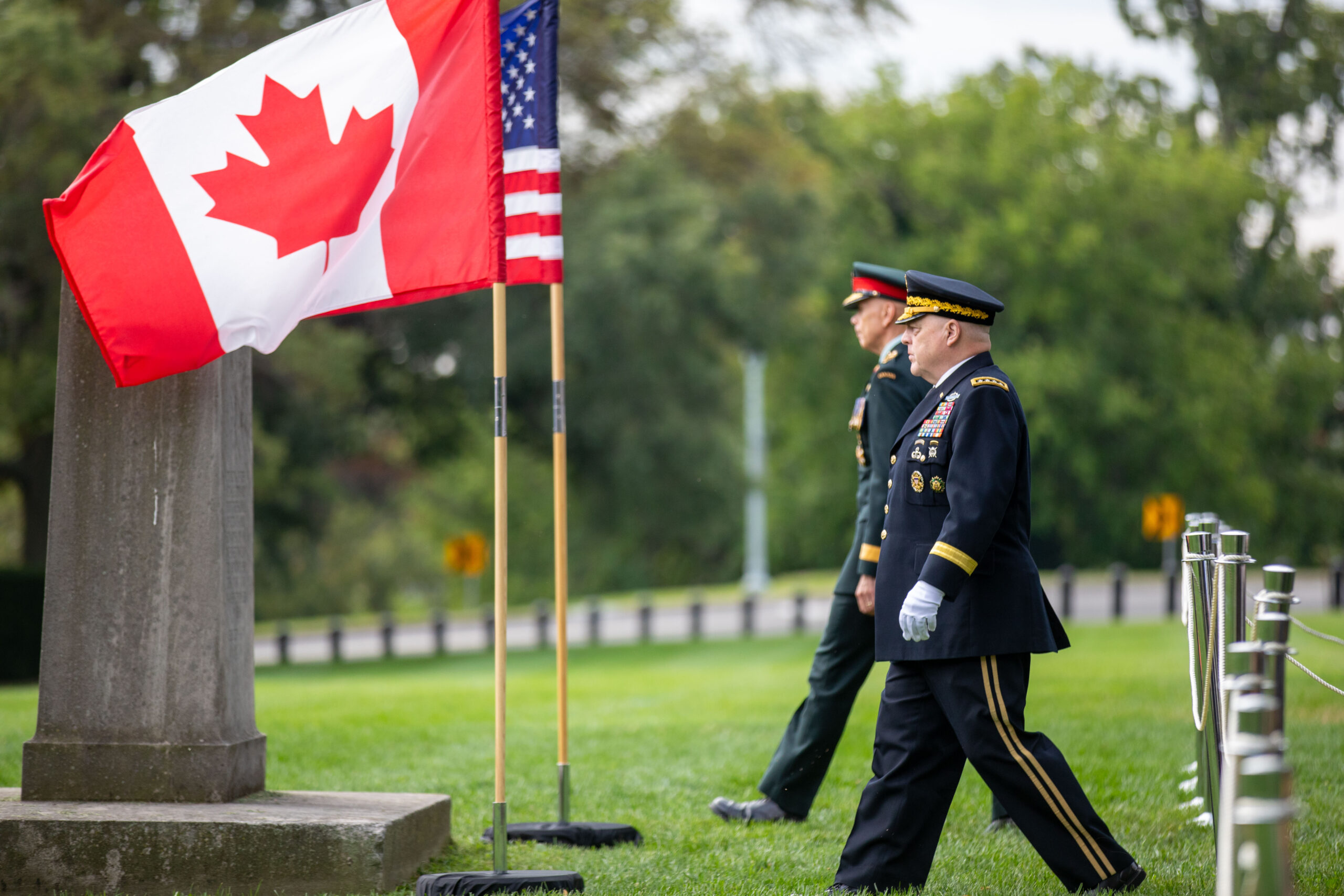
From this perspective, the potential civil-military tensions between a Canadian government wishing to develop sovereign capabilities and a CAF wishing to preserve its close relations with the United States are unlikely to materialize. Certainly, Canadian senior officers adopt a logic distinct from the industrial one articulated by Minister Joly. Their priorities remain operational effectiveness and interoperability with the United States. Questioned about the alleged rupture in Canadian-American relations, the Chief of the Defence Staff, General Jennie Carignan, stated in this regard: “With the United States, we share North America and it is important that we continue this work together. We cannot change our geography and, militarily speaking, it is much easier to do this together because missiles do not know borders.” For the General, the “United States will always remain a priority partner for us.”
This perspective may seem contradictory to Prime Minister Carney’s, who declared in March 2025 that the time for “tight security and military cooperation” with the United States was “over,” because the American neighbor is no longer a “reliable partner.” However, contrary to what this statement and others like it suggest, Prime Minister Carney is not rejecting close collaboration with the United States on defence. Although in May 2025 he repeated that the period of economic and military “integration” between the two countries was “over,” he added forthwith that Canada would continue to collaborate with its neighbor when necessary. This is the case for the “Golden Dome,” for which Mark Carney has expressed interest in participating, as well as the modernization of NORAD, which has been underway since its launch in 2022 and will further integrate American and Canadian armed forces in the surveillance of the North American continent, command and control structures, air armament, infrastructure, and support capabilities.
Thus, while Mr. Carney announced investing in military bases in the country’s North so that “Canada is taking full responsibility for defending our Arctic sovereignty,” the targeted infrastructures (aerodromes, hangars, munitions, refueling) aim to enable the deployment of F-35 fighter jets. Beyond rhetorical inflections, concrete decisions confirm the persistence of a profound strategic interdependence between Ottawa and Washington.
If the decision following the ongoing review of the F-35 acquisition, announced in March 2025 in reaction to the tariff war triggered by the United States, is now linked to the renegotiation of the Canadian-American free trade agreement, there is no doubt that Canadian military personnel wish to maintain the full order of 88 F-35s. A dozen former senior officers of the Royal Canadian Air Force even wrote a confidential letter urging the government not to reduce its F-35 order. The voice of only one of them, discordant, supports the idea of a mixed fleet.
The consensus in favor of the F-35 manifests even among civilians. According to Deputy Minister of National Defence Stefanie Beck: “The importance of having a fifth-generation aircraft cannot be overstated, because that is what our adversaries have, and our role of deterring them and defending Canada and Canadians means we need to have equipment that will create a dilemma in the minds of our adversaries.” Minister of National Defence David McGuinty echoes this. Attempting to explain why the review of the F-35 acquisition, which was supposed to be completed by the end of summer 2025, is still ongoing, he stated that “there are many factors in the acquisition of a fighter aircraft fleet for Canada […]. They have knock-on distributive effects on infrastructure, on training, on interoperability, on NORAD, on capacity – all these factors are part of the examination.” It is worth noting that among the factors not cited by the minister is strategic autonomy.
The only dissonant voice, but barely audible, is that of the Secretary of State for Defence Procurement, Stephen Fuhr. In one of the rare statements developing an argument against the single acquisition of F-35s, Fuhr estimated that a mixed fleet of combat aircraft would “give Canada more options to handle various threats, rather than relying on one tool to solve a problem.” The decision to proceed with the acquisition of an F-35 fleet or to opt for a mixed fleet will therefore constitute a true credibility test for the Carney government.
It should come as no surprise that the DIS does not question North American integration in defence. If it hardly mentions NORAD, the DIS stipulates that “Canada has a long history of working closely with the United States and looks forward to a continued strong Canada-U.S. defence relationship.” Beyond job creation and economic growth, the ambition of the DIS lies in the development of a “robust Canadian defence industry that provides technological and operational advantage to the Canadian Armed Forces and its security partners in their mission to defend Canada.” On one hand, the expression “technological and operational advantage” means for Canadian military personnel the willingness to acquire the best existing combat capabilities in the Western world, i.e., American ones. On the other hand, Philippe Lagassé estimates that the fact that this operational advantage is associated with the “mission of defending Canada” suggests that the defence of North America and operations abroad will continue to favor the purchase of American equipment.
Even the crisis surrounding Greenland has not moved the Canadian position regarding the importance of preserving Canadian-American collaboration on continental defence. Despite a statement that Ottawa supports the sovereignty and territorial integrity of Denmark, Canada deployed no military personnel alongside European troops during the “Arctic Endurance” exercise in Greenland. Despite contingency plans provided for this purpose to the Prime Minister, he preferred to limit Canada’s engagement in Greenland to the deployment of its CF-18s alongside the United States within the framework of NORAD’s “Noble Defender” operation. It is therefore not surprising either that Prime Minister Carney declared last February 28 that “Canada supports the United States acting to prevent Iran from obtaining a nuclear weapon and to prevent its regime from threatening international peace and security.”
***
The Canadian Defence Industrial Strategy does not constitute a strategic rupture, but an economic adjustment within a framework of integration that remains intact. Behind the rhetoric of strategic autonomy, Canada is redefining neither its operational priorities nor its fundamental geopolitical positioning. Capacity choices, NORAD modernization, the centrality of the F-35, and persistent interoperability with the United States confirm that the continental architecture continues to structure Canadian defence policy. The invoked autonomy is above all industrial and accounting: it targets intellectual property, Canadian content, and economic spin-offs, but not the capacity to act militarily in an independent manner.
In this sense, the DIS reveals less a will for strategic emancipation than an attempt to maximize the economic benefits of an assumed interdependence. There is no contradiction between the strengthening of North American integration and the development of “sovereign capabilities,” as long as these are conceived as instruments of growth rather than as foundations of operational and political autonomy. The ambition is not that of an autonomous strategic power, but that of an integrated partner intending to better leverage a system it neither wishes to leave nor radically transform.
Is this choice rational in the face of the breach of trust with the United States, which led Prime Minister Carney to affirm that the United States is no longer a reliable partner? Or is it, on the contrary, a lucid choice given the geographic reality, the integrated defence industry, and the power asymmetry with the United States? If this question deserves an in-depth treatment in another paper, it is appropriate here to note the abyssal gap separating the sovereigntist rhetoric of the Canadian government and its integration practices. This contradiction could translate into failure when Canadians realize that decisions made in Ottawa do not correspond to the promises made to them, or if Washington were to instrumentalize Canadian dependence to impose politically unacceptable concessions. Then, the sovereigntist rhetoric instrumentalized for reindustrialization purposes rather than toward a true strategic inflection would reach its limits and expose the vulnerabilities of structural dependence.
Photo credits: US Army photo by Sgt. Ethan Scofield via Flickr.



Comments are closed.