The Iranian crisis is not merely a matter of airstrikes, threats, and diplomatic statements. It also plays out in the internal realignments of power in Tehran and in the way the regime’s Eurasian partners adapt to them.
Among these key partners, the People’s Republic of China appears less concerned with official, institutional Iran than with operational Iran: the realm of energy flows, logistics networks, and security networks, at the heart of which the Islamic Revolutionary Guard Corps (IRGC) now stands as a central actor.
Several recent indications suggest a rapprochement between Beijing and structures linked to the IRGC. This should neither be overestimated—it constitutes neither a formal alliance nor a complete strategic alignment—nor ignored. It is part of a deeper transformation of the Iranian regime, marked by a relative weakening of the clerical architecture and a rise in the power of military-security structures.
The central question is therefore: what does this rapprochement signify from the perspective of Chinese intentions? Is it a strategic bet on a new dominant actor, or a pragmatic adjustment to a changing internal reality in Iran? During the ceasefire agreed upon in April 2025, this question has become increasingly relevant. The Iranian issue is now more openly part of a triangular dynamic between Washington, Beijing, and Tehran: discussions regarding a potential agreement with Iran, the issue of reopening the Strait of Hormuz, and Sino-American exchanges on crisis management confirm that Beijing is no longer merely an economic partner of Tehran, but a player whose influence Washington also seeks to mobilize.
The argument put forward here is that China does not seek to “bet everything” on the IRGC, but rather to adapt its partnership to an Iran in the process of redefining itself. It incorporates the IRGC as an indispensable interlocutor, while avoiding alignment and maintaining the ability to manage risk. The People’s Republic does not choose the Guardians; it acknowledges their centrality and adapts accordingly.
A rapprochement rooted in concrete practices
The Sino-Iranian rapprochement is based primarily on concrete and increasingly well-documented developments.
More than ever, China has emerged as the main market for Iranian oil, absorbing a considerable share of Tehran’s exports—often estimated at between 80 and 90 percent—through channels that circumvent sanctions. These flows rely on sophisticated mechanisms: ghost fleets, transshipments at sea, and financial and logistical intermediaries.
U.S. sanctions targeting Chinese refineries and transportation networks involved in these exchanges confirm the scale of this reality. Washington explicitly views these alternative channels as supporting the Islamic regime’s economic and strategic resilience.
Beyond oil, more discreet forms of collaboration exist. Several reports mention Iran’s use of Chinese navigation and positioning systems, notably BeiDou, to enhance its military capabilities.
An investigation by the Financial Times, reported by Reuters, also mentioned Iran’s use of a Chinese reconnaissance satellite to improve its surveillance of U.S. military positions in the Middle East. The information remains sensitive and must be handled with caution, but it illustrates the type of sub-threshold cooperation of interest here: not a declared military alliance, but capability contributions that could indirectly strengthen Iranian structures involved in the operational management of the crisis.
Finally, joint naval exercises between China, Iran, and Russia reflect military cooperation that has been expanding rapidly since the 12-day war in June 2025. These interactions do not constitute an alliance in the strict sense, but they help establish communication channels, a dynamic of technological interoperability, and coordination practices.
Taken together, these elements indicate the existence of a collaboration that is still fragmented but increasingly deepening, operating largely through networks linked to the IRGC.
A transformed Iran: the IRGC as the operational center of gravity
These interactions, which have been constantly evolving over the past year, take on even greater significance in the current context of a profound internal transformation of the Iranian regime.
Confirming a trend observable for several years, but accelerated by U.S. strikes and the disappearance of several key regime figures, the Sepāh-e Pāsdārān-e Enghelāb-e Eslāmi (IRGC) is asserting itself even more clearly as a cross-cutting actor, combining military, economic, and logistical functions. The Pasdaran now play an indispensable role in infrastructure, energy networks, and parallel commercial networks.
This evolution does not signify the complete disappearance of clerical power, at least in its formal sense, but it de facto alters the regime’s actual structure. Against a backdrop of sanctions and confrontation, the Guardians are now the only ones capable of ensuring operational continuity—security, flows, logistics—and are thus gaining increased centrality.
Having been the driving force behind the Islamic system for some fifteen years, the IRGC now controls or influences a dominant share of strategic flows, oversees critical networks, and forms the backbone of Iran’s regional projection. Initially conceived as an ideological guard tasked with protecting the revolution and ensuring the regime’s survival, it has gradually expanded beyond this role by infiltrating the economy, infrastructure, smuggling networks, parastatal foundations, and regional militia networks.
Through a combination of security coercion, control of resources, capture of sanctioned markets, and institutional influence, the IRGC has established itself as one of the main operators of real power. This centrality—long-standing but further accentuated by recent shocks—makes it, from China’s perspective, an indispensable gateway for any external actor seeking to maintain functional access to the real Iran.
For Beijing, this transformation requires an adjustment. It is no longer simply a matter of dealing with official institutions, but of navigating a system where real power is increasingly militarized in favour of the IRGC, rather than the regular Iranian army, the Artesh. The latter remains responsible for the conventional defence of the territory, but it remains politically subordinate and far less integrated than the Pasdaran into the regime’s economic, security, and regional networks. The rapprochement with the IRGC thus appears to be an inevitable functional adaptation to an Iran in the midst of transformation.
Convergence under pressure, not alignment
It should be noted, however, that the rise of the IRGC aligns with Chinese interests, albeit in an ambivalent way. On the one hand, it facilitates access to channels capable of operating under sanctions, maintaining flows despite pressure, and operating in secrecy. For a China concerned with securing its supplies, this represents an advantage. But conversely, the IRGC remains the bearer of a strategic logic that generates risks. The Sepāh-e Pāsdārān’s operational culture favors the use of indirect conflicts and the projection of coercive pressure on a regional scale.
The recurring threat of a closure of the Strait of Hormuz precisely illustrates this ambivalence. For Tehran, and even more so for the security networks that shape its regional posture, Hormuz serves as a lever for asymmetric pressure against Washington and its allies. For Beijing, however, this same lever becomes a systemic risk: any major disruption of this strategic passage could undermine the energy flows on which a significant portion of its economy still depends. Yet these dynamics can directly harm China’s fundamental interests, notably the stability of the Strait of Hormuz and the continuity of energy flows.
Beijing is particularly sensitive to this risk. China has repeatedly called for restraint and de-escalation in the Gulf, particularly in light of tensions surrounding the Strait of Hormuz. It has also bolstered its strategic oil reserves, anticipating a possible deterioration of the situation. This is where the relationship with the IRGC takes on its full significance: China needs to maintain a channel with the Iranian actor most directly associated with instruments of regional coercion—not to encourage their use, but to limit the effects of an escalation that would threaten its own interests.
This dual stance—economic engagement and strategic caution—reveals a central logic: China is keen to capitalize on its relationship with Iran without bearing the systemic risks. The issue of Hormuz thus provides a concrete basis for this logic: Beijing accepts the strategic utility of an Iran under pressure, but fears the moment when that pressure might lead to a disruption of the energy flows on which its own energy security depends.
Engaging with the IRGC without becoming its hostage
China does not seek to align itself exclusively with the IRGC. Instead, it adopts a risk management strategy: preserving the benefits of its relationship with Iran while limiting the potential costs of regional escalation. In line with this approach, Beijing maintains its economic ties with Iran and, in effect, contributes to the regime’s resilience, notably through its oil imports, certain transfers of dual-use technologies with military potential, and the maintenance of active trade channels despite sanctions. At the same time, it avoids any direct military involvement, any formal alliance, and any excessive exposure.
This ambivalence is not a contradiction, but the core of China’s strategic prudence. It allows Beijing to benefit from an Iran under pressure—which diverts some of America’s resources and attention—without being drawn into confrontation with Washington. Iran thus becomes a space for indirect competition, where the costs of Sino-American rivalry are partially externalized.
For the reasons analyzed so far, the IRGC occupies a central position in this equation. It enables the Iranian regime to function under constraint by maintaining energy flows, logistics networks, and the system’s security coherence. But it also embodies a logic of action based on asymmetric escalation, capable of triggering uncontrollable dynamics, particularly in the Gulf.
It is this duality that compels Beijing to engage with the IRGC without becoming its captive. China must maintain a connection with the IRGC, as it constitutes one of the main interfaces of Iran’s real power; but it must simultaneously avoid being drawn into its logic of escalation. It therefore does not seek to control it—which would exceed its capabilities and run counter to its interests—but rather to manage the effects of its actions, notably through economic levers and a diplomacy of de-escalation.
The challenge is therefore to preserve an active balance: keeping Iran sufficiently functional so that it remains a useful partner, while preventing the dynamics driven by the IRGC from leading to a major strategic rupture.
Conclusion: convergence without alignment
The growing closeness between China and the IRGC does not constitute a formal strategic alliance. It reflects an adaptation to an internal transformation of the Iranian regime that has been accelerated by the conflict with the United States and Israel.
While taking care not to put all its eggs in the IRGC’s basket, Beijing recognizes that this basket has become indispensable. In a weakened Iran, subject to sanctions and engaged in a protracted confrontation, the IRGC is now a central and indispensable player in the exercise of effective power.
China’s strategy therefore consists of remaining close without aligning, supporting without committing, and influencing without controlling. It aims to preserve the benefits of the relationship with Iran while limiting the risks of escalation.
It is in this ability to navigate between engagement and caution that the distinctiveness of China’s stance lies. It is based neither on an alliance nor on neutrality, but on a nuanced management of dependencies and risks.
In this sense, the phenomenon is less spectacular than an institutionalized alliance, but potentially more significant. It reveals a way to exert influence without direct exposure, to capitalize on a partner under pressure without fully bearing the costs, and to adapt to a changing system without becoming locked into it.
China does not align itself with the IRGC. It adapts to the evolving context in which the IRGC operates—and this is precisely what makes its strategy both difficult to grasp and formidably effective.
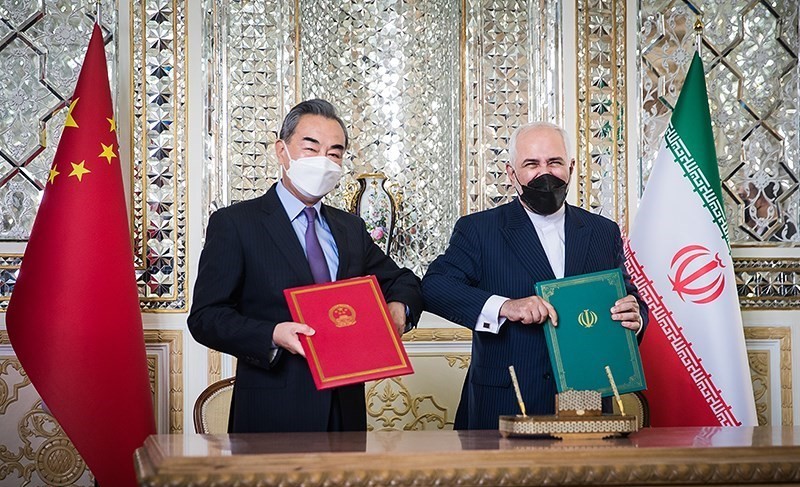
Image Credit: Tasnim News Agency via Wikimedia Commons.




Comments are closed.