
Deterring with Partners: Where should Canada focus its alliances, and to what ends?
Where should Canada focus its alliances, and to what ends? The question sounds forward-looking but, answering it honestly requires confronting a prior problem. I argue that Canada has rarely been in the habit of asking this precise question. My argument proceeds in two steps. First, Canada’s engagement with NATO has over time shifted from active deliberation to reflexive consensus. Today, commitments are perhaps maintained more by institutional inertia than by strategic calculation. Second, and more importantly for this panel, the historical record suggests that breaking this pattern is structurally difficult even when political conditions seem favourable. The Trudeau government’s 1968-69 defence review remains the most serious attempt at strategic reorientation in the postwar period, and its partial failure offers a precise diagnosis of the constraints Canada faces today.
From Deliberation to Consensus
Pierre Elliott Trudeau arrived in office in 1968 with a coherent intellectual critique of Canada’s alliance posture. In his view, defence policy had come to drive foreign policy rather than the reverse: Canada’s commitments to NATO shaped its strategic identity and behaviour, rather than flowing from a prior definition of national interests. He was not alone. A faction within the Liberal party, led by former Finance Minister Walter Gordon, had been making comparable arguments since the mid-1960s, contending that Western Europe’s postwar recovery had made the scale of Canada’s military contribution to the continent both unnecessary and costly. Outside government, a number of academics lent intellectual legitimacy to the challenge. These were not peripheral voices; they represented a genuine attempt to subject a foundational assumption of Canadian foreign policy to rational scrutiny.
What those debates looked like matters. In the House of Commons during the spring and summer of 1969, the NATO question produced genuine ideological conflict. These conflicts were not merely partisan. Indeed, they were not only between parties, but within the governing Liberals themselves. For instance, Liberal MP Warren Allmand called for complete withdrawal of Canadian forces from Europe; his Liberal colleague Norman Cafik strongly opposed any reduction. The Progressive Conservatives argued that the Soviet threat that had created NATO had not diminished; the NDP argued, in Tommy Douglas’s words, that the logic of Trudeau’s own position pointed toward full withdrawal. These were substantive disagreements about strategy, interest, and the purpose of alliance membership. They were, in short, exactly the kind of debate that sound defence policy requires.
Contrast this with Canada’s parliamentary debates since 2022. Following Russia’s full-scale invasion of Ukraine, support for NATO and for Ukrainian military assistance has been, in the words of one Liberal MP, marked by a striking “unanimity.” The Progressive Conservatives had long favoured comprehensive military assistance; the Liberals followed; even the initially hesitant Bloc Québécois and NDP moved into alignment within weeks of the February 2022 invasion. By 2023, what had briefly been a contested question had become politically settled.
The recent depoliticization of the debate is, in itself, revealing. Consensus is not the same as strategy. When alliance commitments cease to be contested, they also cease to be examined. To be clear: the argument here is not that Canada should disengage from NATO or withhold support for Ukraine. Both commitments may be well-justified on their merits. The concern is rather with the reasoning process, or its absence. A commitment arrived at by default, because it was never seriously questioned, is a fragile one. It cannot be calibrated, sustained, or adapted to changing circumstances with any coherence. Active and engaged NATO membership, and meaningful support for Ukraine, are most defensible and most durable when they are understood as instruments serving identifiable Canadian objectives, not as ends in themselves.
The Structural Limits of Reorientation
If the habit diagnosis is accurate, the more consequential question for this panel is whether it can be corrected, and under what conditions. Here the Trudeau case is instructive, and rather sobering. Trudeau entered office with substantial political capital: a majority government, a clear personal mandate, and a willing Cabinet faction. At that time, public opinion was largely in favour of recalibrating Canada’s engagement within NATO, and the bilateral relation with the United States. The formal defence review he launched in May 1968 was comprehensive, and the directive establishing it explicitly opened to question the full range of strategic commitments Canada had accumulated since 1949. By any standard, the conditions for meaningful reorientation were as favourable as they were likely to be.
What followed nonetheless fell well short of transformation. The outcome, which would amount to a reduction of Canadian forces in Europe from 10,000 to 5,000 troops, was real but modest. It was achieved only after prolonged internal conflict and at considerable political cost. Three categories of constraint account for the gap between ambition and result.
The first was bureaucratic. The Department of External Affairs produced internal studies recommending the maintenance of Canadian forces in Europe before Trudeau had even won the Liberal leadership. One of them is particularly telling. Its author, Norman Robertson, was among the principal architects of the postwar internationalist consensus. He contended that Canada’s military presence in Europe was the currency that bought Ottawa a seat at the table of Western consultations. As such, withdrawing forces would mean voluntarily surrendering the diplomatic leverage on which Canada’s international influence depended. This logic was deeply embedded in the institution and proved remarkably resistant to political direction from above.
The second was allied. Washington and European capitals applied sustained pressure throughout the review process. American officials made clear their expectation that Canada would maintain its European commitment. Allied governments, facing their own domestic pressures to reduce defence spending, were reluctant to accept a Canadian precedent for disengagement. A tense Cabinet meeting in December 1968 exposed the depth of the conflict: Trudeau’s questioning of NATO’s strategic premises prompted his Defence Minister, Léo Cadieux, to fear he was dismissing the Soviet threat entirely, while External Affairs Minister Mitchell Sharp reportedly considered resigning. The compromise reached at the March 1969 Cabinet meeting relied on the phrasing “planned and phased reduction” rather than withdrawal, preserving Cabinet unity precisely by remaining ambiguous enough to mean different things to different ministers.
Thirdly, Trudeau did produce an articulated alternative framework: the 1971 White Paper on Defence established an explicit hierarchy of priorities, placing the protection of Canadian sovereignty first, the defence of North America second, NATO commitments third, and peacekeeping fourth. Defence policy, it stated plainly, must reflect and serve national interests rather than drive them. This was precisely the kind of prior strategic framework the review had been criticised for lacking. Yet even this relatively clear ordering proved insufficient to durably reshape institutional behaviour. By the mid-1970s, Trudeau had become an active advocate of NATO and the hierarchy the White Paper had established quietly eroded. Subsequent governments did not replicate the exercise. More than fifty years later, Canada has still not conducted a comprehensive integrated foreign policy review of comparable scope. What the episode reveals, then, is not that a framework was absent, but that producing one is not the same as institutionalising it. The bureaucracy, the allies, and the logic of accumulated commitments proved more durable than the policy document meant to reorder them.
What This Means for Canada’s Alliances and Partnerships?
Where Canada should focus its alliances and to what ends? Canada must rebuild the habit of deliberate strategic reasoning that the late 1960s debates, whatever their outcome, at least exemplified.
The present moment makes this more urgent, not less. American disengagement from European security commitments, the rapid growth of European defence spending, and the ongoing war in Ukraine have altered the structural conditions of the transatlantic relationship. Canada’s military assistance to Ukraine has been substantive in absolute terms and politically uncontested domestically, but when measured against economic capacity it ranks among the most modest of NATO contributors. More importantly, the political conditions that have made it uncontested, meaning cross-party consensus, low media salience, and a permissive public environment, have also removed the incentive to think carefully about what Canada is trying to accomplish and whether current commitments are calibrated to achieve it.
The Trudeau episode identifies what a more deliberate approach would require: a prior articulation of the interests Canada’s alliances are meant to serve; an explicit hierarchy of commitments when priorities compete; and sufficient institutional and political preparation to sustain a chosen course against the predictable pressures of allied expectation and bureaucratic inertia.
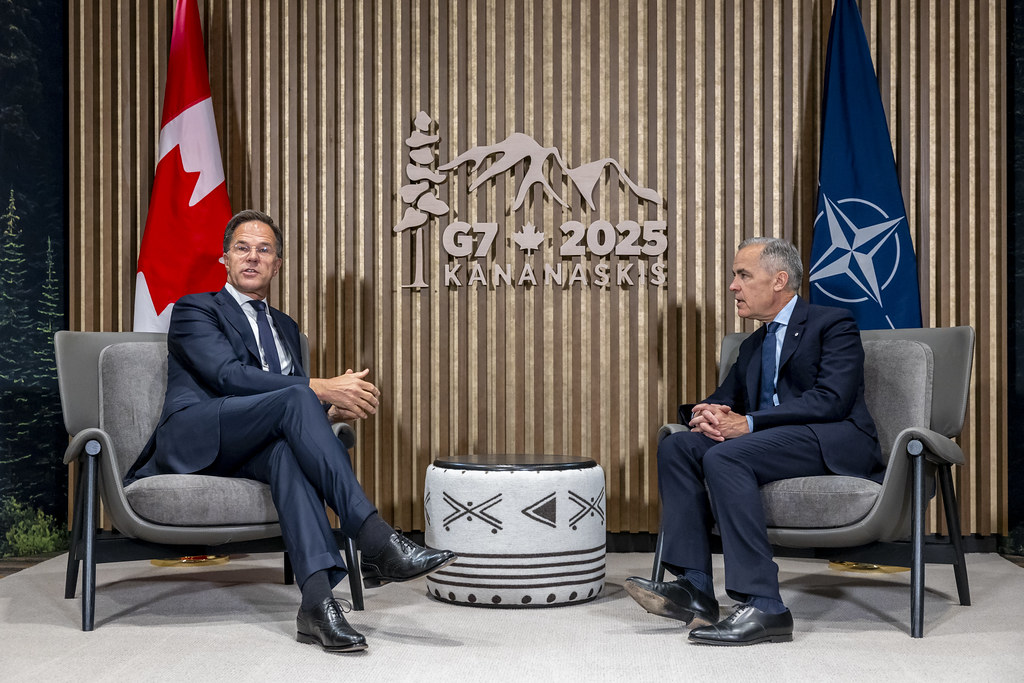
Image Credit: NATO via Flickr, CC BY-NC-ND 2.0.



Comments are closed.