
Executive Summary
The federal government has launched Canada’s largest rearmament program in decades: planned spending by the Department of National Defence (DND) rises from $30.6 billion in 2024-2025 to $51.7 billion in 2026-2027. The Defence Industrial Strategy (DIS) of February 2026 aims to award 70% of acquisitions to Canadian firms within ten years, up from roughly 43% at the outset.
The Government of Quebec wants the province to capture its share. This report therefore examines the extent to which Quebec’s industry is positioned to take part in this effort. It draws on the following databases: the Defence Capabilities Blueprint (DCB), the prospective capabilities of the Canadian Armed Forces (CAF), and the contracts awarded by DND to Quebec suppliers between 2020 and mid-2026.
Five findings structure the report.
- Federal demand is broad, but its value is concentrated. Of the 130 DCB projects, the 26 worth more than one billion dollars account for most of the decisions, in three clusters: C4ISR and space, NORAD modernization and the Arctic, and naval recapitalization. Half of the largest projects do not yet have an acquisition contract, and the first deliveries of the major projects are concentrated around 2027-2033. The envelope actually available to industry is narrower than the announced totals. On the one hand, only the trajectory to 2.6% of GDP is planned and funded, as Budget 2026 confirms. On the other hand, if the budget structure holds (20 to 25% in capital), a budget of 3.5% of GDP would represent about $30 billion in acquisitions per year in 2035, of which $21 billion in Canada, compared with $14 billion today.
- The programs that matter most to industry are outside the DCB. Submarines, fighters and icebreakers are the files around which the ecosystem is reorganizing fastest. None of the three appears in the DCB, yet they combine the largest amounts of the decade with the most imminent decisions.
- Europeanization is real, but American dependence remains intact. Canada has become the first non-European country admitted to the European Union’s SAFE mechanism, and German, Swedish, Italian, Norwegian and French suppliers hold an unprecedented place. But of the twenty major acquisition contracts under way, American prime contractors hold 41% of the value and European ones 8%. The Canadian share (51%) rests almost entirely on the shipyards. The outlook points to a slow and partial decline in the foreign share, driven by a few champions and by space and air programs, but not to a change in structure.
- DND’s direct contracts in Quebec are concentrated on supporting existing fleets. Aircraft maintenance, along with the production of ammunition and uniforms, are the three main categories of contracts awarded. This explains both the concentration of value, with five firms capturing 64% and 66 firms 92%, and the way it is awarded, 43% being granted without competition.
- Quebec’s position is solid in its historical strengths and fragile in its growth drivers. Of the DIS’s ten sovereign capabilities, Quebec is in a position of strength on four (training and simulation, aerospace, ammunition, in-service support) and of weakness on two (space, uncrewed systems), as shown by the absence of drones and missiles from Quebec’s production. Growth poles can nevertheless be anticipated in satellite manufacturing, autonomous systems and tactical communications.
The report draws implications at three levels. At the federal level, they bear on the feasibility of the DIS. At the Quebec level, the government would benefit from building its strategy around three defence economies that call for different instruments (procurement decisions for fleet support, benefits policy for subcontracting on major programs, and financing for the emerging economy). Finally, for industry, the new mechanisms (Defence Investment Agency, Industrial and Technological Benefits policy, partnership with the European Union) are concrete points of entry, and tomorrow’s operational requirements are so many signals of the contracts to come.
Read the full report here.
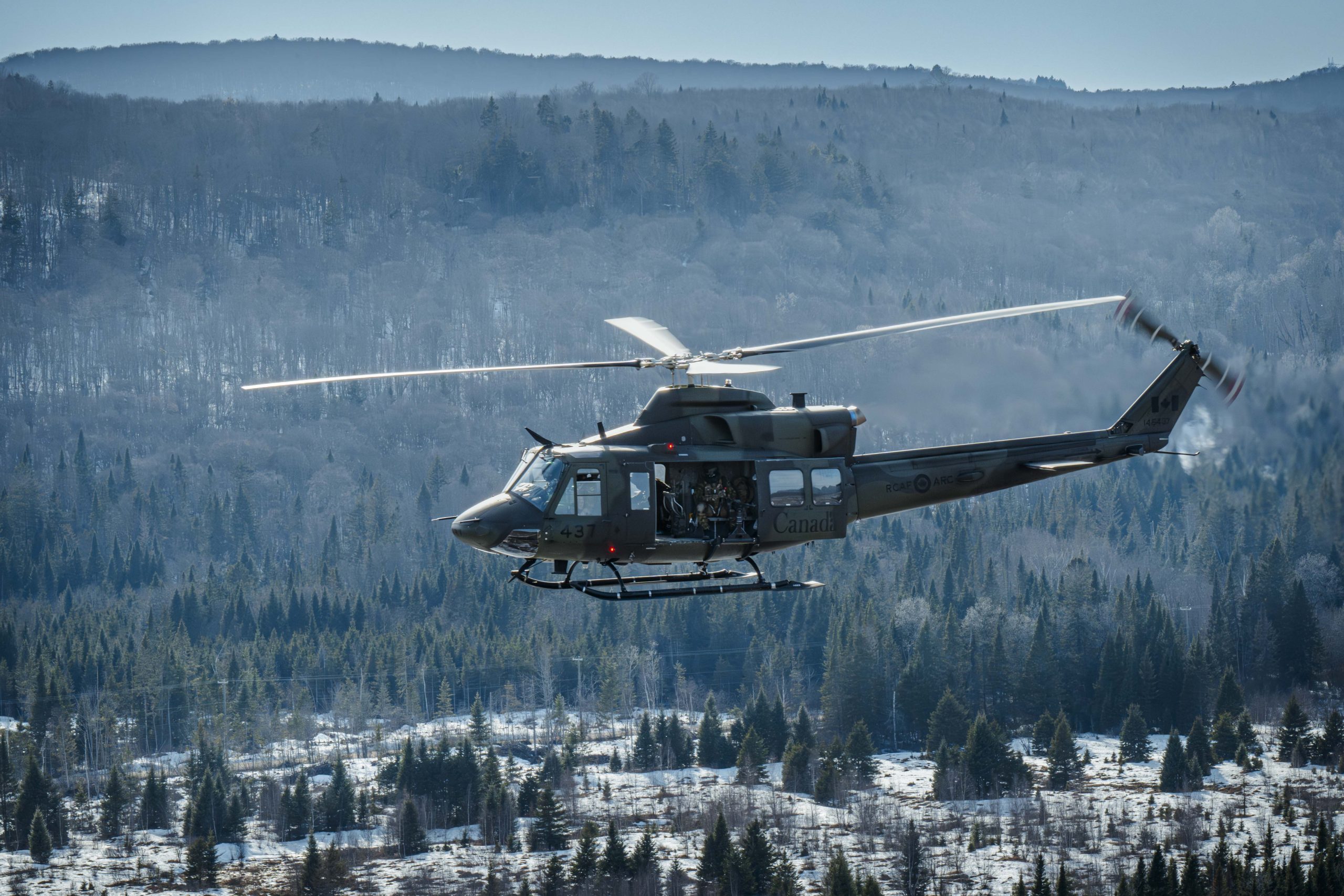
Image credits : Corporal Liam Stagg, Canadian Armed Forces, via Combat Camera, © 2026 DND Canada — Crown copyright.





Comments are closed.