
Hay’at Tahrir al-Sham’s (HTS) shift from one of the most radical jihadist movements of the Syrian war to a globally acknowledged ruling authority of post-Assad Syria is one of the most extraordinary political developments of the past decade in the Middle East. When HTS forces led by Ahmed al-Sharaa (formerly known as Abu Mohammed al-Jolani) entered Damascus and deposed Bashar al-Assad’s regime in December 2024, members of the global community faced an unprecedented challenge: how should states and international organizations respond to a former al-Qaeda affiliate suddenly positioned as Syria’s ruling authority? Many analysts were surprised to learn that diplomatic normalization occurred quickly and practically seamlessly: by late 2025, al-Sharaa had addressed the United Nations General Assembly, held bilateral meetings with leaders from Europe and the Middle East, and met with the President of the United States. This unprecedented acceptance of what had previously been classified as a “terrorist organization” challenges long-held notions in both scholarly and governmental debates about the conditions under which extremist groups moderate and gain legitimacy.
Traditional theories of moderation, particularly the inclusion-moderation hypothesis, suggest that ideological softening is primarily due to domestic factors such as election participation, integration into legislative bodies, coalition building, and the necessity to compete for public support. These paradigms alone are insufficient to explain the trajectory of HTS, as the group did not participate in any elections, was not included in Assad’s formal Syrian political process, and was completely excluded from peace talks for more than a decade. Instead, HTS moderated under the burden of long-term diplomatic isolation, strangling sanctions, and exclusion from all major multilateral negotiations or institutional forums about Syria’s future. Thus, one can say that HTS reformed not because it was welcomed into the political arena, rather, because its exclusion imposed tremendous costs that could only be reduced by a major adjustment of its ideological posture and strategic activity.
In this way, the international system actively shaped the emergence of HTS, rather than simply reacting to it: foreign states, multilateral organizations, and transnational institutions acted as both gatekeepers and accelerators, fostering a structural context in which moderation became the only realistic path for HTS’s survival and objectives.
The group’s leaders appear to have realized this reality early on. Beginning in the mid-2010s and accelerating after the Islamic State’s territorial defeat in 2019, HTS began an internal process of de-radicalization and political rebranding aimed not only at appeasing local communities under its control in Idlib, but also at anticipating conditions under which it might one day be treated as a legitimate actor by outside powers. This strategic moderation worked as both an internal restructuring of power and a conscious posture toward the international community’s expectations.
Understanding HTS’s moderation and later global recognition necessitates a framework that goes beyond domestic inclusion to investigate the intersection of internal adaptability and systemic international pressure.
This hot take elaborates on a complete new aspect that illustrates how HTS, originally presented as part of the global jihadist vanguard, evolved into a state-building actor capable of interfacing with the world’s most powerful countries. It contextualizes the group’s transition to moderation by looking at both its radical origins and the gradual internal and external influences that transformed its conduct in the decade leading up to Assad’s demise. Then it examines how these preparatory processes enabled HTS to gradually become a diplomatically, recognized ruling authority in 2025, describing the unprecedented wave of international engagement, institutional transformations within Syria, and the emergence of a new foreign policy doctrine under al-Sharaa. Finally, the report considers the broader implications of HTS’s trajectory for international approaches to radical non-state actors, arguing that under certain structural conditions, exclusion rather than inclusion can generate incentives for moderation and political transformation.
From Jihadist Vanguard to Proto-State Actor: The Long Era of Strategic Moderation
To understand the significance of HTS’s rebranding, it is necessary to first examine the movement’s early ideological foundation, which was firmly founded in Salafi-jihadist doctrine and international revolutionary goals.
When Jabhat al-Nusra arose in 2012 as al-Qaeda’s Syrian affiliate, its leaders saw Syria as a springboard for a larger regional transformation. Its discourse questioned the legitimacy of existing Arab states, advocated for the construction of an Islamic rule based on strict Sharia, and accepted violence as the only means of achieving political change. It saw sectarian minorities as adversarial groups that threatened its survival, condemned all forms of diplomacy with other nations, and derided Western-backed rebel forces as puppets supporting global power interests. Its early administrative decisions, including the institution of Sharia courts and religious police, revealed a rigorous theological bent that appeared unchangeable.
However, beginning in the mid-2010s, HTS faced several structural challenges that gradually made its maximalist posture untenable. The group’s international isolation was more severe than that of other armed non-state actors in current conflicts: for instance, unlike the Taliban, Hezbollah, and the Iraqi Sadrist movement, HTS lacked an external state patron prepared to provide diplomatic protection, as well as a formal channel into discussions. The United States, Russia, the UN, and regional states insisted on its exclusion from any negotiations. This isolation was strengthened by extensive sanctions, which made even providing humanitarian assistance to HTS-controlled territory extremely difficult. This combination of coercive and normative constraints created a political context in which HTS could not access resources, external aid, or diplomatic channels unless substantially changing its ideological position and behaviour.
At the same time, HTS was going through internal adjustments prompted by the reality of territory control in northwest Syria. As the war entered a protracted stalemate after 2019, HTS was tasked with governing a heavily populated region that housed millions of internally displaced civilians. The movement realized, perhaps reluctantly, that ideological purity did not equate to administrative viability. Local populations required services, institutions, and political stability. Providing these needed technical skills, bureaucratic procedures, and collaboration with foreign humanitarian organizations was extremely difficult as all of which were incompatible with HTS’s early doctrinal rigor. This domestic governance problem interacted with international influences, producing what can be defined as a “internal-external nexus” of moderation dynamics.
The group’s first significant ideological shift occurred with its formal separation from al-Qaeda in 2016-2017. Although hardliners within HTS resisted it, this decoupling was a critical step in separating the group from transnational jihadism and signalling a more local and pragmatic approach. Far from being a mere symbolic gesture, the division promoted a larger organizational reorganization that excluded diehard transnational jihadists, elevated pragmatic leaders, and allowed the group to frame its struggle in national rather than global terms. Again, Jerome Drevon and Patrick Haenni have identified three concurrent mechanisms at work during this period: the transition from a Salafi-jihadist doctrinal frame to a more jurisprudential and locally grounded religious discourse; the dismantling or marginalization of extremist factions within HTS ranks; and the dilution of ideological training to reduce transnational jihadist commitments among new recruits. Together, these actions changed HTS’s brand and enabled the next step of strategic repositioning.
A second milestone was the formation of the Syrian Salvation Government (SSG) in 2017, which HTS backed and increasingly relied on as a civilian administrative partner. While the group retained ultimate authority, it portrayed the SSG as a technocratic organization capable of providing services, establishing institutions, and representing local communities. This guise of civilian government enabled HTS to interact indirectly with international actors and humanitarian organizations that previously refused to collaborate with declared terrorist groups. More crucially, it demonstrated HTS’ readiness to distinguish between military and civilian positions, which would later prove critical in making the movement appear governable in the eyes of other powers.
Over the years, HTS commanders, particularly al-Jolani, launched a systematic communication campaign to reshape the group’s image: public remarks prioritized justice over vengeance, institution building over revolutionary struggle, and local priorities above global jihad. On the one hand, interviews with international media outlets depicted HTS as a Syrian movement with no plans to strike Western interests, emphasizing the importance of unified civilian government in the northwest. Such message was specifically designed to match the expectations of international audiences, assuring them that HTS did not constitute a transnational threat. Despite these narrative changes, the group was nevertheless characterized by practices such as punishments and political exclusion. On the other hand, international help was severely constrained, economic infrastructure deteriorated under the weight of embargoes, and the SSG struggled to maintain basic services. This paucity, combined with the lack of formal financial outlets, compelled HTS to embrace a more pragmatic approach: Al-Jolani began to focus on investment zones, economic diversification, agricultural self-sufficiency, and industrial reactivation rather than zakat or Islamic redistribution. He outlined a vision of ‘economic dignity’ based on productivity rather than charity, which is significantly more consistent with neoliberal development aspirations than the organization’s previous ideological convictions.
By the time HTS started its main assault against the Syrian regime in late 2024, the organization had spent nearly a decade building a narrative of localized control, institutional rationality, and ideological moderation. This tale was more than just superficial: while true internal ideological reform is difficult to judge, there is no doubt that HTS modified its institutions, language, and practices in order to portray itself as a legitimate political actor capable of gaining national power. These changes were not evidence of normative internalization, rather of strategic adaptation, an attempt to “perform moderation” in preparation of the international community’s conditional expectations.
In other words, HTS altered because remaining unmodified would have resulted in perpetual isolation. The fall of the Assad regime offered HTS with an unparalleled opportunity while also subjecting it to increased scrutiny. As soon as Damascus fell under its control, HTS had to demonstrate that the moderation it had practiced for years could be translated into statecraft obligations. The group’s next stage of development – its emergence as a globally recognized governing authority – would demonstrate the extent to which its strategic moderation and rebranding have been successful.
Moderation Reward: HTS as an Internationally Accepted State Actor
The ousting of Assad in December 2024 marked the start of a fundamentally new political scenario in Syria, in which HTS, long denounced as a terrorist organization, unexpectedly became the major authority governing a fractured and tired country. What ensued was an unprecedented diplomatic shift in recent Middle Eastern history, considering Syria’s isolation on the international arena. Within weeks, Syria went from an international pariah to a regime courted by Arab countries, European ministries, and Western diplomats. This abrupt change was not an accident, but rather the result of years of intentional moderation that positioned HTS to meet the international community’s conditions for recognition. This recognition resulted from pragmatic considerations by international governments and institutions seeking stability, influence, and cooperation in the post-Assad period, rather than normative support of HTS’s ideology.
After conquering Damascus, Ahmed al-Sharaa proclaimed the formation of an interim administration made up of technocrats and former HTS members. The new authorities dissolved or merged armed factions into a national army, established ministries designed to operate in accordance with international bureaucratic standards, began discussions on a constitution-writing process, and laid the ground for future elections. These efforts were aimed to show HTS as a responsible political group that adheres to global governance standards. Al-Sharaa also established transitional justice and missing persons committees, both of which have long been championed by foreign groups, sending early hints that the new administration intended to address grievances accrued over decades of war and repression.
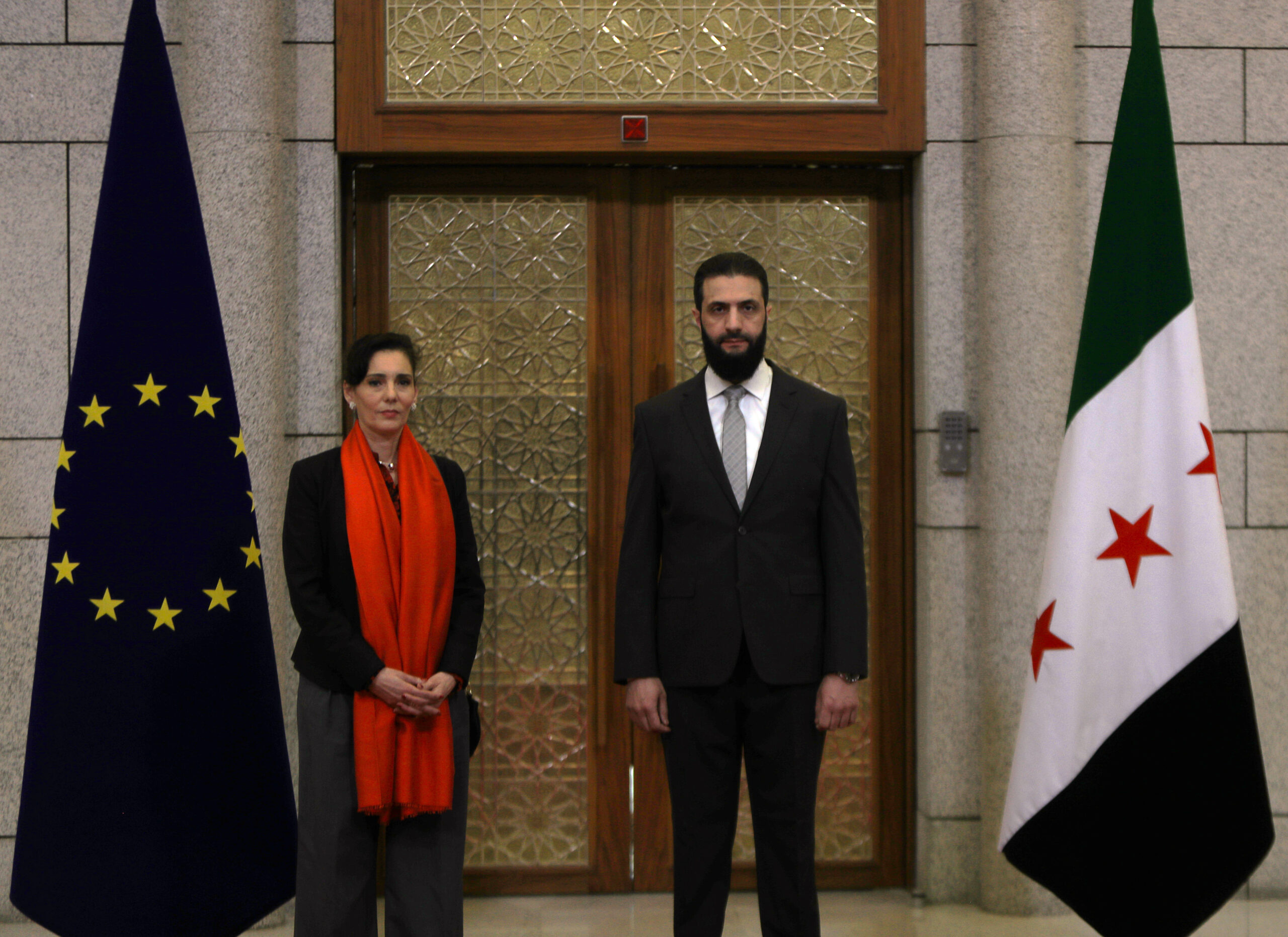
In parallel, an unprecedented flood of diplomatic activity occurred. Germany and France sent their foreign ministers to Damascus in early January 2025, marking the first official Western visits to Syria in more over ten years. Days later, Qatar’s Prime Minister, as well as Saudi Arabia’s Foreign Minister, visited Damascus, highlighting a coordinated regional readiness to interact with the new administration. Qatar’s Emir’s visit has been the first head of state visit to Damascus barely weeks after Assad’s demise. This represented a symbolic endorsement of HTS’s transition that would have been unthinkable even a year ago.
Normalization continued in February 2025. The Director-General of the Organisation for the Prohibition of Chemical Weapons paid a visit to Damascus to restart Syria’s compliance procedures, allowing the new authorities to demonstrate their adherence to international law and compliance. Meanwhile, U.S. Representatives Cory Mills and Marlin Stutzman made their first semi-official congressional visits since 2012, followed months later by a bipartisan Senate group. These encounters marked a gradual shift in Washington’s stance: while the US did not instantly remove HTS from its terrorist list, it did acknowledge that Syria’s political reality necessitated a pragmatic kind of engagement.
The diplomatic effort peaked in late May 2025, when al-Sharaa travelled to Riyadh for a momentous meeting with the U.S. President Donald Trump. The conference sparked conversations on sanctions relief and counter-terrorism cooperation, marking the first formal presidential dialogue between the United States and Syria since 2000. In the months leading up to the summit, al-Sharaa travelled to Turkey, the United Arab Emirates, Qatar, France, Azerbaijan, and Russia, with Jordan’s King Abdullah II hosting him in Amman. The subsequent invitation to address the United Nations General Assembly in September 2025 marked the symbolic conclusion of HTS’s journey from ostracism to acceptability.
This diplomatic momentum was bolstered by HTS’ efforts to develop a clear foreign policy framework: in his UN speech in September 2025, al-Sharaa laid out a strategy based on balanced diplomacy, regional stability, and economic revival. He promised to cooperate with UN fact-finding missions, thanked Arab and Western countries for aiding Syria’s transition, and positioned his administration as a defender of both national sovereignty and international legal obligations. His plea for an immediate suspension of hostilities in Gaza was particularly notable, as it sought to link Syria with broader international humanitarian themes while avoiding direct conflict with Western and Israeli security concerns. HTS’s selective restraint mirrored the necessity to avoid upsetting important Western actors whose cooperation was vital for sanctions relief and reconstruction help.
In domestic administration, HTS maintained a moderate stance to obtain international acceptance: the interim administration strengthened departments in charge of infrastructure, health, and education, and restored channels for humanitarian NGOs within controlled parameters. The SSG’s previous administrative experience in Idlib served as a foundation for the development of national institutions, allowing the government to claim administrative competence. Furthermore, HTS sought to reassure minority groups that they would not fear persecution, in sharp contrast to the group’s previous sectarian statements. These demonstrations of tolerance were utilitarian rather than ideological, signifying an intentional surrender of earlier traditions to fulfil international expectations of pluralistic administration.
Foreign powers rewarded this moderation not because of ideological solidarity with HTS, but because the alternatives (state collapse, militia fragmentation, renewed jihadist expansion) were considerably less appealing than accepting the new ruling administration. Regional powers like Turkey, Qatar, and Saudi Arabia saw an opportunity to secure their borders, restrict refugee flows, shape Syria’s destiny while re-balancing the regional international order. Western powers recognized the pragmatic value of engaging a force that had abandoned transnational jihad, exhibited internal discipline, and held strategically important territory. Even Russia changed its stance, shifting from a vehement defence of Assad to conditional acknowledgment of the new government as genuine interlocutors.
These diplomatic engagements served not simply as acknowledgment but also as channels for ongoing conditionality. Each visit, conference, and institutional engagement reinforced expectations that HTS will remain moderate and follow rule-based governance. The process established what can be defined a circular feedback loop, in which moderation earned recognition, which then pushed more moderation for the sake of political survival and international legitimacy.
The administration could not easily return to radical behaviour without suffering significant reputational costs and compromising the diplomatic and economic benefits it had worked to secure.
Critics contend that HTS’s moderation is largely performative, driven by opportunistic calculations rather than a genuine ideological shift. This concern is not unfounded, as the group’s Salafi-jihadist roots and history of doctrinal rigidity raise doubts about the depth and durability of its transformation.
However, several structural and institutional factors suggest that a return to radicalism would entail prohibitive costs. First, HTS has invested heavily in state-building measures by creating ministries, initiating constitutional processes, and integrating technocrats whose dismantlement would undermine governance and legitimacy, and signalling a potential return to radicalism which may isolate again the group and the country. Second, the new administration’s survival is now inseparable from international recognition: sanctions relief, humanitarian access, and reconstruction aid hinge on sustained moderation, making reversal economically and diplomatically self-defeating. Third, the marginalization of hardline factions and the dilution of transnational jihadist networks within HTS have reduced the organizational capacity for ideological purposes. Finally, a circular feedback loop of conditionality – where each diplomatic engagement reinforces expectations of rule-based governance – has locked the group into a path where moderation is not merely tactical but structurally “sticky.” While skepticism remains warranted, these dynamics indicate that HTS’s current posture reflects a strategic adaptation that is increasingly difficult to undo.
Underneath this facade of normality is a core tension: HTS’s moderation appears to be purely opportunistic, motivated by the potential benefits of international acceptability rather than a real moral shift of its intellectual worldview. Its ability to maintain this moderation will be determined by internal dynamics, specifically its ability to constrain hardline factions, manage economic crises, and meet the cultural demands of a war-traumatized populace. Meanwhile, international actors must strike a difficult balance between assisting Syria’s stabilization and preventing the normalization of an armed movement with controversial ideological foundations.
Conclusion
The emergence of HTS from a globally isolated jihadist faction to the internationally recognized ruler of post-Assad Syria exemplifies a complex and frequently neglected political transformation mechanism. Unlike traditional moderation theories, which emphasize inclusion and domestic incentives, HTS demonstrates that exclusion, when consistent, multilateral, and materially constraining, can create the conditions for radical movements to recalibrate their ideological frameworks and institutional behaviour. The report’s main point is that HTS moderated not because it accepted international rules, but because the world system made conformance a need for survival and legitimacy.
This trajectory demonstrates the structural influence of the international order in defining the paths available to armed non-state actors. It demonstrates how, rather than being a natural feature of state actors, legitimacy may be extended to previously radical organizations through performative adherence to global standards. At the same time, HTS’ moderation is situational, purposeful, and potentially reversible. Its long-term viability will be dependent on persistent international participation, ongoing domestic governance changes, and the group’s ability to translate tactical moderation into a more profoundly institutionalized and normative political identity.
HTS’s example provides an important precedent for how the international community should address other armed groups operating in similarly fractured circumstances. It implies that under certain conditions—particularly when external isolation severely limits access to resources and legitimacy—radical actors may become surprisingly open to strategic moderation. However, the hazards of such interaction remain significant, and the distinction between pragmatic adaptation and real ideological transformation will need to be closely monitored in the coming years.
Image Credit: European Commission, CC BY 4.0.



Comments are closed.